Toronto · September 8, 2026
The Toronto Transit Turnaround
Public transit is the backbone of our transportation system. Olivia Chow has neglected it, leaving it less reliable and less safe, with less revenue to invest in better service. As a result, pre-COVID riders have been reluctant to come back either on weekdays or on weekends.
Our city will not get moving again until we make the TTC once again the trusted, better way for commuters, friends, families, shoppers and visitors.
The fact ridership still needs to rise by 25% to reach 2019 levels is a scandal. The fact many are scared to take the TTC because of harassment or other unpleasant experiences is unacceptable.
Olivia Chow has mishandled transit to the point where service, safety and reliability are in question. Her regressive fare policies are reducing revenue and ridership.
She has not even begun to address the issue of unfunded infrastructure repairs, which are also undermining service and reliability.
This is a plan to end this steady deterioration since 2023 and restore confidence in the TTC. It all starts with buses, LRT, streetcars and subway cars where people feel safer.
To stabilize revenue, we need to end the mayor's costly giveaways. She has frozen fares and reduced caps for three years, yet ridership is still declining this year.
She has given a break to people who can afford to pay, while failing to help parents, youth, seniors, students or low-income families. We need to stop these mounting losses; steady the books; plan to fix what's broken; ensure everyone feels safe. Then cost it honestly.
In short, Olivia Chow is offering regressive discounts and poor service with no plan to fix problems or end the financial bleeding. As mayor, Chris will do the opposite.
Here is the current fare table:
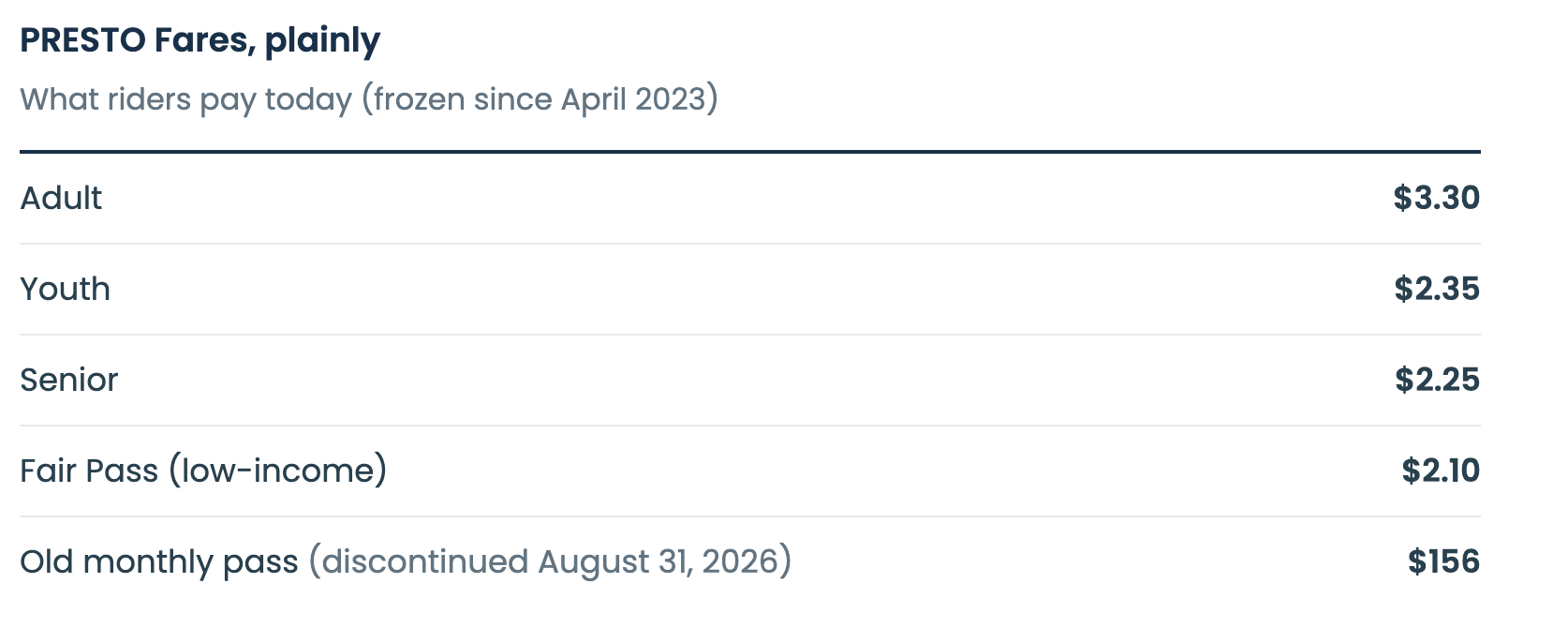
Our fare plan will do the following:
Maintain the 47-ride cap for all fare categories;
Increase adult fares by 20 cents during rush hour (6:30-9:30 am and 3:30 to 7 pm) on Tuesdays, Wednesdays and Thursdays to $3.55 cash and $3.50 PRESTO;
Increase adult fares by ten cents (to $3.40 for PRESTO and $3.45 cash) at all other times.
Reduce youth and senior fares by fifteen cents;
Reduce post-secondary monthly passes to $120;
Reduce the Fair Pass Transit Discount by ten cents to $2 per ride;
For occasional riders/visitors, offer a one-day adult single pass for Saturday or Sunday for $9; and a weekend pass for $15.
For the same occasional riders/visitors, offer a weekend family pass for two adults and up to three youths for one day ($18) or two days ($30).
These measures would increase ridership by two to four million per year, while increasing revenue by $43 million revenue. Olivia Chow has kept adult fares frozen for three years, bleeding revenue from the TTC and allowing reliability to decline further. Her regressive fare proposal in this campaign would reduce revenue by $19 million in 2027 and $37 million in 2028. The foundation for our plan is fare reform that stabilizes revenue, reinforces progressive pricing and increases ridership, especially on weekends.
But the real change begins with measures to end fare evasion, enhance safety and improve reliability of service, which are the keys to restoring ridership.
Step 1 — End Fare Evasion
Fare evasion costs the TTC $125 to $140 million a year. Today about 12 percent of riders don't pay, more than double the rate in 2018. In 2010, the reported fare evasion was less than two percent and in 2000 less than one percent. On streetcars today, almost 3 out of every 10 riders don't pay. Use of child fare cards by adults is reportedly widespread. Our target will be to reach six percent fare evasion by 2028 and below two percent by 2030. To this end, as mayor, Chris will propose the following actions to council and the TTC:
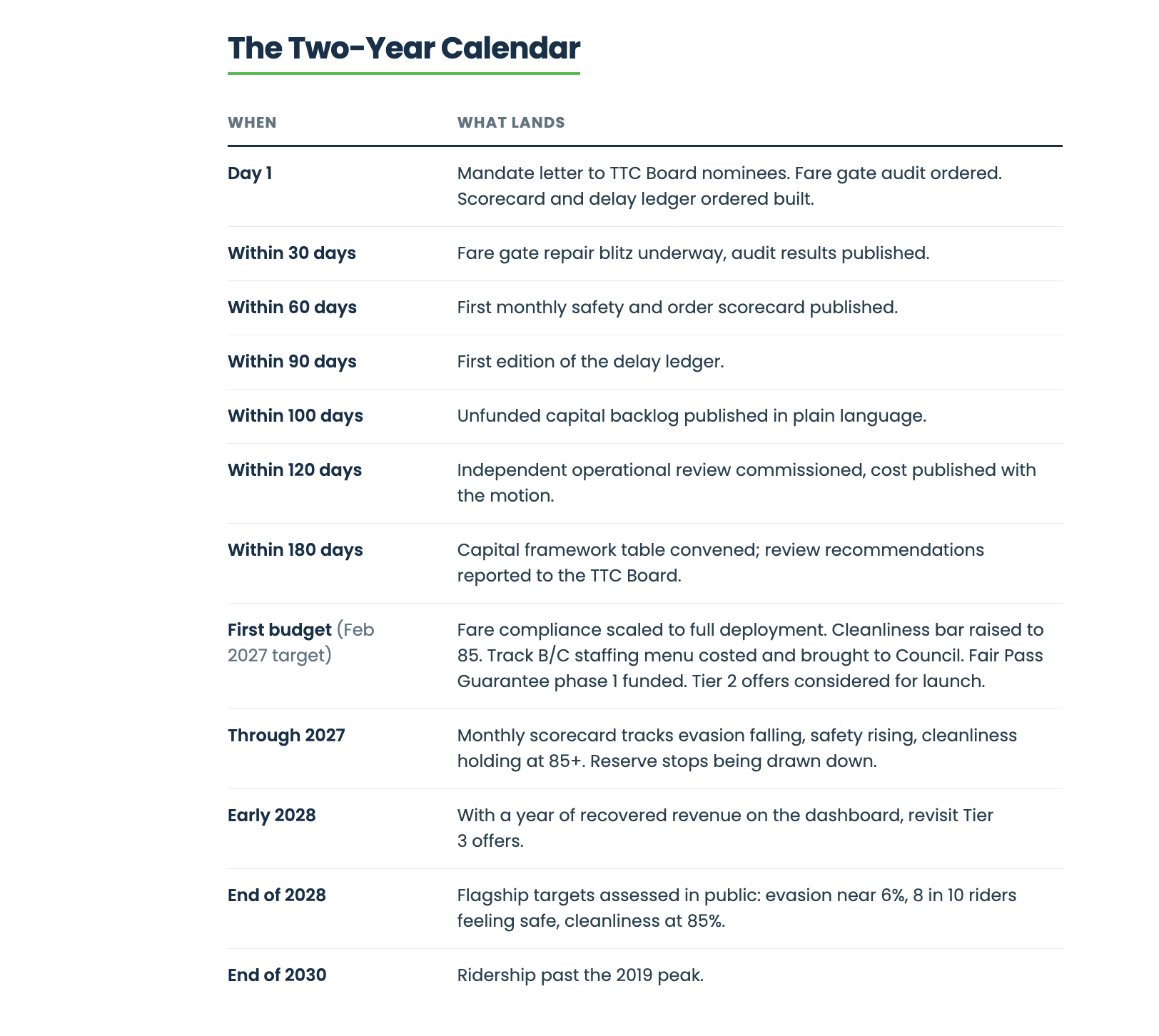
A full, system-wide audit of every fare gate, working and broken (crash gates included), with results published within 30 days, repairs initiated immediately, and a new public gate uptime standard to ensure the fix stays fixed.
An expanded fare inspector team, including a significant plainclothes contingent, to move well beyond the 2025 pilot and 2026 enhancement. This $8 to $10 million a year expense will pay for itself, since the test returned four dollars for every dollar spent.
Close the children's fare card loophole. A 2023 TTC study found 94 percent of child card taps were fraudulent. Children's cards will look and scan differently from adult cards, with tighter controls on who gets one, following the Auditor General's recommendation.
Step 2 — Restore the Reserve & Review Spending
The TTC's financial cushion is known the stabilization reserve. Olivia Chow has been draining it to cover deficits caused by her misguided policies. By the end of 2026, it will have only $25 million left after $35 million was spent to balance this year's budget. At this pace, the reserve will be gone in a few years, which is dangerous for the TTC system.
In addition, cost recovery at the TTC has dropped from 65-70 percent before the pandemic to 47 percent today. As a result, TTC operations are more dependent than ever on other City of Toronto revenue, as well as funding from other levels of government, with a dwindling reserve.
This needs to change. As mayor, Chris will use savings from fare enforcement to balance the TTC budget, restore the reserve and improve service. To find operational savings, he will commission an independent review of scheduling, maintenance, and vehicle availability within 120 days.
He will also ensure there is a public dashboard giving the latest TTC financial statements detailing the status of the reserve and revenues from outside the TTC system. The dashboard will also provide ridership numbers and report fare evasion trends.
Step 3 — Fix What's Physically Broken
Operational and capital backlogs must not be blurred together. Fare gates are an operating-budget problem, to be solved in step 1 above. The capital backlog is of an entirely different order of magnitude, with a different funding source: $54 billion in needs against $16.7 billion funded, a $37.3 billion gap, including Line 2 signalling and the $4.1 billion Bloor-Yonge expansion. The Eglinton East LRT extension has not yet been budgeted; nor have projected cost overruns on the Waterfront East LRT. As mayor, Chris will:
Within 100 days, publish the unfunded capital backlog (including for Eglinton East and Waterfront East LRTs) in plain language, so it stops compounding in the dark.
In his first budget, table a prioritized ten-year state of good repair plan, with the first hundred items named, costed and dated.
Publish a ledger of capital delays and their impact on service for every transit project in which Toronto has a stake, with promised date beside actual date, promised cost beside actual cost, updated quarterly.
Within 180 days, convene Ottawa, Queen's Park and other big city and GTHA mayors on a permanent capital framework, and report publicly what was asked for and what was answered. We will never make promises on the basis of unconfirmed financing, but we will commit to convening players at the table and producing a report.
Step 4 — Make It Safer, Cleaner & More Reliable
About six riders in ten currently tell the TTC they feel safe (57 percent on the CEO Report's “satisfaction with safety” measure; 62 to 64 percent on an earlier, different “feel safe” question, which are not interchangeable). The TTC's own target is eight in ten by 2028. Offences against customers are already down 28 percent since December 2022, but these surveys do not measure the views of riders who are staying away.
As mayor, Chris will:
Publish within 60 days the first edition of a monthly safety and incident scorecard, reporting offences per million boardings, percent of riders who feel safe, incident response times, station cleanliness, elevator and escalator uptime, washrooms in service.
Pair special constables with Toronto Community Support Service teams to ensure those in crisis on the platform or in vehicles get help and the system stays safe for everyone else.
Raise the cleanliness bar from the current 76 percent target to 90 percent, above the Station Makeover pilot target, which already hit 85-plus in all six stations.
Set a public target of eight in ten riders feeling safe by the end of 2028, adopted as a city and TTC commitment with monthly reviews.
Strengthen one reporting channel (building on the Safe TTC model) with a published resolution clock, including a 48-hour clock for graffiti, broken fixtures or washroom failures.
Publish data detailing delays and their causes, especially during rush hour, and take continuous action to reduce such incidents and enhance reliability.
Step 5 — Ending Inappropriate Use
The TTC system should not be used for consumption of alcohol, cannabis, nicotine/tobacco or unregulated/illegal substances. It should not be a substitute for the shelter system. Transit riders should never be subject to intimidation, verbal abuse, harassment or assault. The unhoused and those with untreated addictions deserve the dignity of a bed, a meal and proper care.
As mayor, Chris will empower TTC special constables, fare compliance officers, Toronto Community Crisis Service teams, shelter staff and others to work together to prevent inappropriate use of the TTC system and provide better options to the unhoused and those with untreated addictions. They will also work together to prevent, with Toronto Police Service support when necessary, intimidation, verbal abuse, harassment or assault of TTC customers.
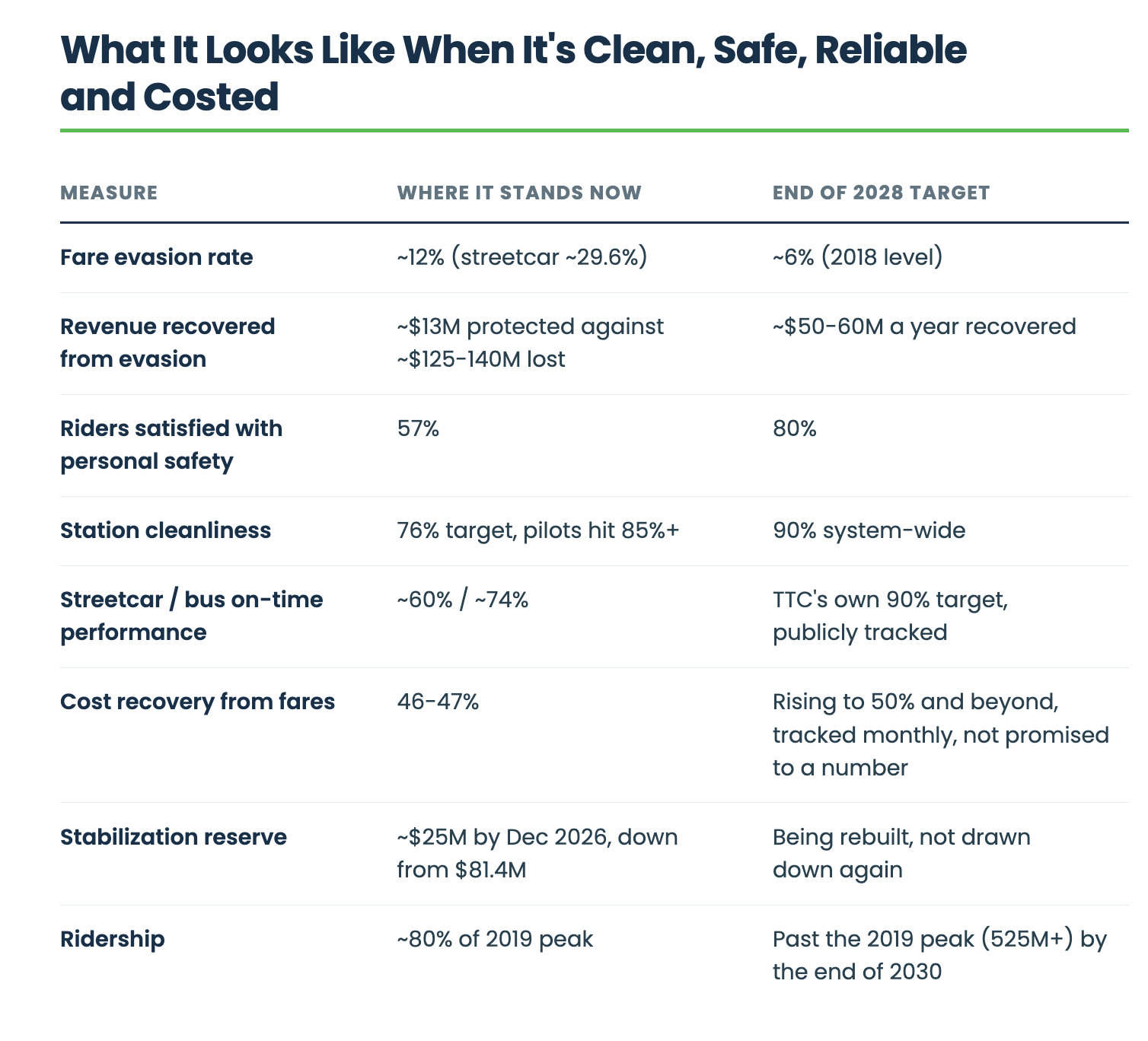
We want riders to have confidence in public transit. They need to know gates and elevators work; trains and buses are on time; other streetcar riders have paid the fare; and they will not be harassed or intimidated by other passengers. As mayor, Chris will ensure those in crisis get help, without disrupting service. We will make stations, washrooms and platforms clean. We will report updates, good or bad. We will address new issues immediately and ensure service improves continuously. We will advertise this enhanced performance to Torontonians and visitors to drive rising ridership and increasing revenue.
Media contact: (437) 907-1376 | press@chrisalexander.ca | chrisalexander.ca